


 Back
Back Working in a group with other students is part and parcel of university study. Quite a few people worry about it, and some have real problems with it. This activity looks at the main issues people have with group work and gives you some practical tips for your own study.
Background
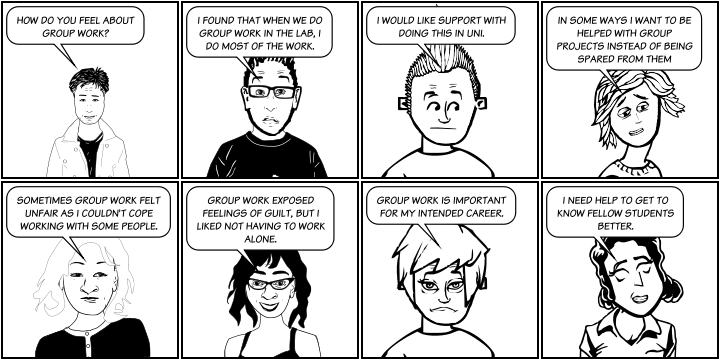
Group work came up a lot in the Autism&Uni surveys. Some people found it really useful in terms of helping them develop skills they needed for work and social life later on. Other people really struggled with it, especially if they felt that they were doing more work than other people.
This is a common issue for non-autistic people, too. There is no perfect way to put together groups or make them work well, so tutors also find it challenging, but getting to grips with group work is a worthwhile thing to do and it’s an important part of many courses for this reason.
What’s good and bad about group work?
It’s understandable to worry about it if you have had problems in the past, but anticipation is often worse than reality. What do you think are the good and bad points about group work?
Who will I work with?
In the workplace, you rarely get to choose who you work with, but hopefully the work you do will be related to your strengths and skills. University is similar
If students get to choose their own groups, this can feel empowering and you can work with people you already know.
Ideally, you would choose to work with people based on their strengths and have a variety of different skills and preferences in the group.
The lecturers try to mix groups using various methods so the unpredictability can be hard to adapt to the first time you are placed in group work.
Strengths and weaknesses
Everyone has preferred roles in a group. Some people are natural leaders. Some people are very creative. Some are brilliant at making sure all the notes get made and meetings get booked. Others are amazing at bringing the group together. Some people make fabulous slides, or public speaking. Most people have a mixture of talents and preferences, and areas that need more development. So it is good to be open and have group rules decided upon before starting your assignment/presentation work.
How could this affect me?
Some autistic students enjoy group work more than any other part of their course, as it enables them to work with others with support and a common goal and this helps them with social and work relationships later on. Others worry a lot about it, but either way most courses have group work at some point and it is better to take a proactive approach so you can make the most out of the experience.
It is best to be very specific – just saying you’re good or bad at something or love or hate it without giving a very clear idea of what that is in relation to the group is unhelpful to others. If you need help or guidance when things may not be going well, then reach out for advice to the ASC centre or your lecturer.
What to do next?
Speak to your ASC tutor if you need support with group work
Practical tips
- Think about telling the group you are autistic and how it affects you – if you feel comfortable to share this information
- Make a list with two columns: in the left column put the things you are most worried about relating to group work and in the right column, write down how you might be able to resolve these issues.
- Discuss this list with a trusted person at home or at uni, maybe a parent, friend, or a tutor.
Questions to think about
These are things you can talk to your personal learning support tutor about. Some are good practice :
- Telling the group you are autistic and how it affects you-if you choose to.
- Set ground rules for group work and communications, such as how often you will meet up and/or email each other, internal deadlines etc
- Establishing a student buddy within the group
- Arranging an in person and/or online meeting with your group.
In addition, here are some questions to think about and plan strategies around:
- How do you decide who the leader is and who does what? Will this rotate?
- How would you divide up work fairly?
- How do you get everyone to do their fair share of the work?
- What about when someone doesn’t turn up?
- How would you handle it if someone doesn’t speak English that well?
- When should you talk to the tutor about problems and what do you need to do first?
About the author
Provided by Leeds Beckett University